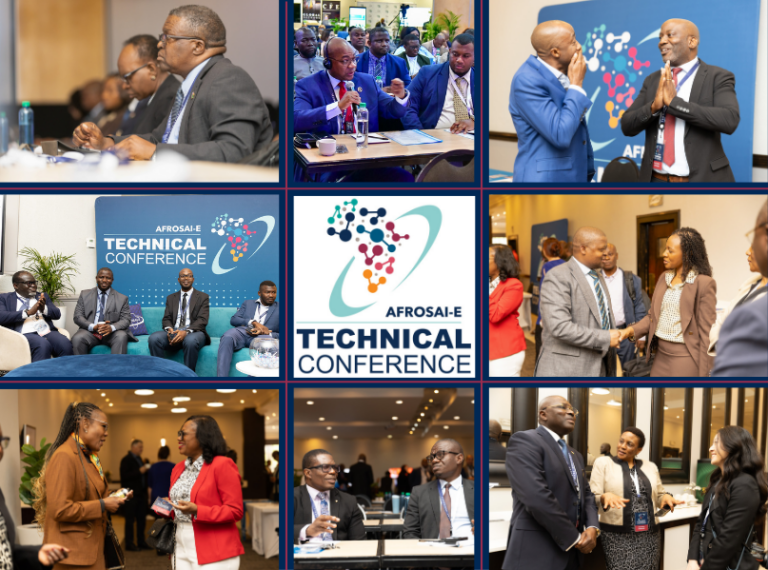
Johannesburg, South Africa | 6–8 October 2026
The 21st AFROSAI-E Technical Conference concluded in Johannesburg on 8 October 2026, following three days of discussions that challenged Supreme Audit Institutions (SAIs) to rethink how they use audit evidence, anticipate emerging risks and contribute to stronger governance and accountability.
Held under the theme “Strategic Intelligence for Stronger Governance”, the Conference brought together Auditors-General, senior SAI leaders, governance partners, experts from across the continent and beyond, and over 250 participants who tuned in via the livestream. Through three interconnected lenses — Insight, Foresight and Oversight — delegates explored a central question: how can SAIs move beyond identifying governance failures towards generating intelligence that informs decisions, strengthens accountability and delivers greater public value?
A recurring message was that producing credible audit findings, while fundamental to the SAI mandate, is not sufficient on its own. Lasting governance improvement depends on understanding the systemic causes of weaknesses, recognising risks before they escalate, and ensuring that evidence reaches those with the responsibility and authority to act.

Insight: Looking beyond individual audit findings
The opening day explored how SAIs can develop a deeper understanding of the governance environment by connecting audit evidence with wider fiscal, institutional and development perspectives. The emphasis was on recognising that meaningful governance insight comes not only from the evidence SAIs generate, but also from understanding the broader systems and conditions in which public institutions operate.
SAIs have an important and unique perspective, but we become stronger when we understand the intelligence available elsewhere in the governance ecosystem and when others are able to make meaningful use of the intelligence we produce. – Meisie Nkau, AFROSAI-E CEO
Following the official opening by AFROSAI-E CEO Meisie Nkau, the first day featured remarks from Hilde Dahl, Head of Development Cooperation at the Royal Norwegian Embassy in South Africa, who contextualised the Conference discussions within the changing global development-financing landscape.
Her contribution highlighted the growing importance of domestic resource mobilisation, sound public financial management and strong public institutions in supporting sustainable development, particularly as countries navigate increasing fiscal pressures and evolving development financing arrangements.
She also drew attention to the critical role of SAIs in strengthening accountability, promoting responsible stewardship of public resources and contributing to fiscal resilience. These perspectives provided a broader development context for the Conference, reinforcing why credible audit intelligence and effective public financial governance are increasingly important to countries’ long-term development prospects.
In her keynote address, Auditor-General of South Africa Tsakani Maluleke challenged delegates to look beyond individual audit findings and consider the patterns they reveal across institutions, sectors and government systems.
Drawing on the Auditor-General of South Africa’s consolidated reporting, she illustrated how recurring weaknesses in financial management, institutional capability, procurement and accountability can reveal deeper governance risks. The value of such intelligence lies not simply in documenting what has gone wrong, but in helping decision-makers understand why problems persist, what may happen if they remain unresolved, and where intervention is needed.
Dr Mariska McKenzie reinforced this message by presenting a case study of the fiscal crisis in South Africa’s Limpopo provincial government. Her analysis demonstrated that many warning signs, including capacity constraints, financial pressures and recurring audit weaknesses, had been visible before the crisis emerged. The challenge was not necessarily a lack of information, but the failure to connect available evidence early enough to recognise the developing risk and respond.
Auditor-General of Kenya Nancy Gathungu broadened the discussion to fiscal sustainability, emphasising the importance of a whole-of-system understanding of public finances. She highlighted the need to consider not only reported debt, but also contingent liabilities, guarantees, state-owned enterprise exposures and other commitments that may create future fiscal pressures.
The day’s panel discussion on Accountability Partners in the Governance Ecosystem brought together Winnie Mageto of the Collaborative Africa Budget Reform Initiative (CABRI), Loot Janse van Rensburg of the African Peer Review Mechanism (APRM) and the Auditor-General of Ghana, Dr Pamela Graham.
The discussion examined how audit intelligence can be strengthened by connecting it with evidence held by other governance institutions. A key message was that no single institution has a complete view of the governance environment. Ministries of finance, public-sector institutions, regional bodies, civil society and citizens each contribute different perspectives that can help explain not only what has happened, but why.
For SAIs, this reinforces an important distinction: institutional independence must be protected, but independence should not mean isolation. Meaningful engagement with the wider accountability ecosystem can strengthen the relevance and impact of audit work without compromising the SAI mandate.

Foresight: Anticipating change and making better audit choices
The second day shifted attention from understanding existing governance challenges to anticipating future developments and using that intelligence to inform strategic decisions.
Dr Marvellous Ngundu, from the Institute for Security Studies’ African Futures and Innovation programme, opened the day by introducing the role of foresight and scenario analysis in navigating uncertainty.
His keynote challenged delegates to move beyond assuming that current trends will continue unchanged. Foresight, he emphasised, is not about predicting a single future. It is about examining plausible developments, recognising emerging signals, and considering how today’s decisions may shape future outcomes.
An Executive Conversation moderated by Andrew Kellei from AFROSAI-E brought together Moortaza Jiwanji of UNDP, Michelle van Rooyen of the Institute of Security Studies, and Natashia Soopal of SAICA to explore the implications for institutional leadership and governance. The discussion highlighted the importance of organisational culture, ethical leadership, adaptability and the ability to recognise risks that cut across traditional institutional and sectoral boundaries.
Delegates were encouraged to consider whether their institutions are sufficiently equipped to identify emerging governance challenges, challenge established assumptions and respond to a changing environment.
The interactive session “Digitalisation for Smarter, More Forward-Looking Audit Planning”, led by Fredrick Bobo of AFROSAI-E, featured contributions from Andrew Broeders of Sherpa Enterprises and Liz Nambuya, Director of Strategy, Planning and Administration at SAI Uganda.
Drawing on AFROSAI-E’s digitalisation initiative and practical SAI experience, the discussion explored how digital capabilities can help institutions connect information, identify emerging risks and make more informed audit planning decisions. The conversation also highlighted persistent implementation challenges, including access to auditee data, data quality, interoperability, institutional skills, and integrating technology into audit processes.
The central message was clear: digitalisation is an enabler, not an end in itself. Its value lies in strengthening professional judgement and strategic decision-making, rather than simply generating more information or automating ineffective processes.
The afternoon panel, “Turning Foresight into Audit Priorities”, brought the discussion to the practical choices facing SAIs. Moderated by Nonhlanhla Ndaba of AFROSAI-E, the session featured the Auditor-General of The Gambia, Cherno Amadou Sowe and George Phiri of the INTOSAI Development Initiative (IDI).
Drawing on the AFROSAI-E and IDI Planning for Audit Impact initiative, the discussion examined how environmental scanning and a broader understanding of the governance landscape can inform strategic audit planning. SAI The Gambia’s experience provided a practical illustration of the value of looking beyond the traditional audit universe. Its broader assessment of potential audit areas expanded the institution’s view from just over 100 auditees to more than 1,500 potential areas and entities requiring consideration.
The experience reinforced an important principle: SAIs cannot audit everything. Strategic planning therefore requires deliberate choices about which risks matter most, where audit attention can add value and what impact the institution seeks to achieve.
Oversight: Connecting evidence to decisions and accountability
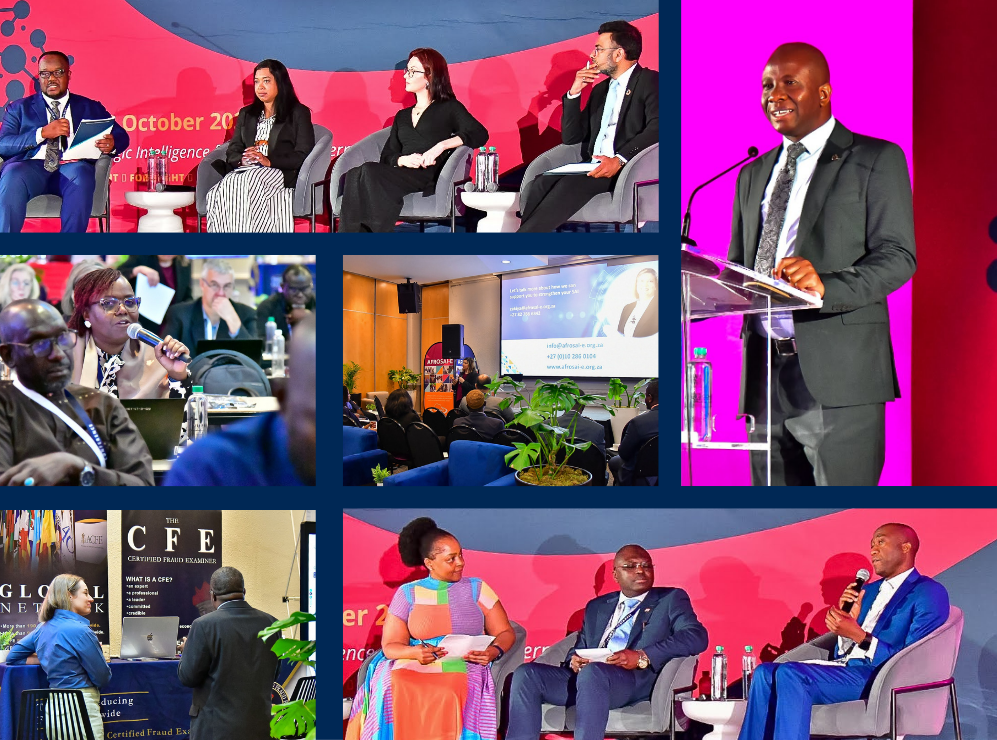
The final day examined how strategic intelligence can influence public policy, strengthen accountability and contribute to meaningful governance improvement.
In her keynote address, “Turning Governance Intelligence into Better Policy: The Case of South African Municipal Finance”, Professor Nara Monkam, Head of the Public Policy Hub and Chair in Municipal Finance at the University of Pretoria, challenged delegates to distinguish between the visible symptoms of governance failures and the underlying conditions that produce them.
Using South African municipal finance as a practical case study, she demonstrated that recurring audit findings may arise from different causes, including institutional weaknesses, capacity limitations, structural constraints or shortcomings in policy design.
An effective response therefore requires more than identifying non-compliance or repeating corrective recommendations. It requires a credible diagnosis, informed by connecting audit evidence with fiscal, administrative and citizen information.
Professor Monkam also emphasised the importance of accurately assigning accountability. Poor institutional performance may reflect decisions within management’s control, but it may also be shaped by broader financing arrangements, economic conditions or structural constraints. Understanding these distinctions is essential to determining who is responsible for what and identifying appropriate corrective measures.
Her message was particularly relevant to the role of SAIs: the response must fit the diagnosis. Addressing a visible symptom without understanding its underlying cause risks allowing the same governance failures to recur.
The Conference concluded its substantive programme with the panel discussion “From Audit Findings to Governance Impact”. Moderated by Jessica Du, Editor and Vice President of the INTOSAI Journal of Government Auditing, the panel brought together Lebogang Ramafoko, Executive Director of Corruption Watch; Dr Rorisang Lekalake, Director of Analysis at Afrobarometer; and Harold Maloka, Corporate Executive at the Auditor-General of South Africa.
The discussion brought together complementary perspectives on institutional accountability, citizen experiences, public engagement, and communicating audit findings. It reinforced the importance of connecting what audit evidence reveals about the functioning of public institutions with what citizens experience in their daily lives. It also highlighted the need to make complex governance information accessible and relevant to different audiences, including policymakers, legislatures, civil society and the public.
The underlying challenge is not simply to produce credible evidence, but to ensure it is understood, used, and acted upon.
Connect & Explore: Bringing practical tools and resources closer to delegates
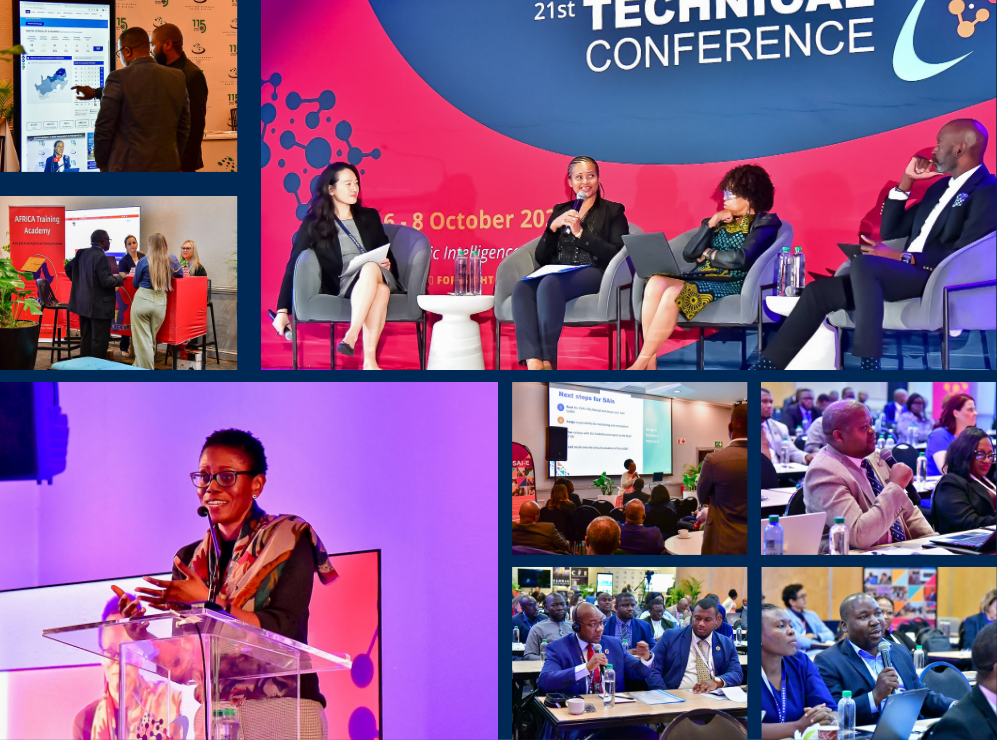
Beyond the formal conference programme, the “Connect & Explore” networking breaks gave delegates opportunities to engage with AFROSAI-E’s latest technical resources, explore practical tools, and connect with organisations supporting public-sector auditing and professional development.
Over the three days, AFROSAI-E hosted a series of technical demonstrations, giving delegates an opportunity to learn more about new and emerging resources designed to strengthen SAI capabilities.
On Day 1, Gorden Kandoro presented the AFROSAI-E Model Public Audit Act, highlighting a resource intended to support strong legislative frameworks for independent and effective public-sector auditing.
On Day 2, Zakiya Fareed introduced the new exposure drafts of the Communication and Stakeholder Engagement Handbook and the Impactful Reporting Guide. These resources are particularly relevant to the Conference’s emphasis on ensuring audit intelligence is communicated effectively, reaches the right audiences, and drives meaningful action.
On Day 3, Fredrick Bobo demonstrated AFROSAI-E’s newly developed Audit Recommendations Tracker, a tool designed to support the monitoring and follow-up of audit recommendations. Nonhlanhla Ndaba also introduced the newly launched Quality Management Manual and Monitoring and Remediation Guideline, supporting SAIs in strengthening their quality management systems and addressing identified weaknesses.
The networking and exhibition space also featured ACFE South Africa, the Africa Training Academy and the Auditor-General of South Africa, giving delegates opportunities to engage with their work, exchange experiences and explore potential areas of collaboration.
Together, these activities complemented the strategic discussions taking place in the conference sessions. They reinforced a key message running throughout the programme: turning intelligence into impact requires not only new ways of thinking, but also the practical tools, institutional capabilities, and professional connections to translate those ideas into action.
From conference discussions to institutional action
Across the three days, several important implications emerged for the future work of SAIs.
First, recurring findings demand deeper analysis. Repeated weaknesses may indicate that corrective actions have addressed immediate symptoms while leaving underlying institutional or systemic conditions unchanged. SAIs can strengthen their contribution to governance by connecting evidence across audit cycles, institutions and sectors to identify these patterns.
Second, strategic intelligence requires a broader field of vision. Audit evidence becomes more powerful when considered alongside fiscal information, institutional assessments, emerging risk indicators and citizens’ experiences. Collaboration with other accountability partners can strengthen this understanding while preserving SAI independence.
Third, foresight must influence institutional choices. Anticipating emerging risks has limited value unless it informs audit priorities, capability development and resource allocation. With finite audit capacity, SAIs must make deliberate decisions about where their work can contribute the greatest public value.
Finally, credible evidence does not automatically lead to better governance. The impact of audit intelligence depends on the quality of its diagnosis, the relevance of its recommendations, how effectively it is communicated, and whether those responsible for corrective action respond.
These messages point to a broader shift in how SAIs can understand and strengthen their contribution to public accountability: from reporting individual weaknesses towards providing a clearer picture of governance systems, future risks and the actions needed to improve performance. The discussions emphasised the distinctive role of SAIs in providing independent, credible and decision-useful intelligence that enables other institutions to fulfil their responsibilities more effectively.
A renewed commitment to public value
In closing, AFROSAI-E encouraged delegates to carry the discussions beyond the Conference and consider what their institutions could do differently. The challenge is to make fuller use of existing audit evidence, pay greater attention to emerging risks, strengthen strategic audit planning and communicate findings in ways that support meaningful action.
The three conference lenses provide a continuing framework for this work: Insight strengthens Foresight; Foresight sharpens Oversight; and effective Oversight generates new Insight.
Ultimately, the success of strategic intelligence will not be measured by the volume of information produced, but by its contribution to better decisions, stronger accountability and improved outcomes for the people whom public institutions serve.
AFROSAI-E extends its appreciation to all speakers, panellists, moderators, partners and delegates who contributed to the Conference and to the continuing dialogue on strengthening governance across the region.